LoreMonetization20266 min read
Subscription vs IAA vs IAP: Why Mobile Apps Make Money So Differently
Two apps can have the same number of users and generate completely different revenue. Here's why, and how the three major monetization models shape everything from UA strategy to product design.
After spending years working across gaming, subscription products, and mobile apps, one thing I’ve learned is that not all revenue is created equally.
Two apps can have the same number of users and generate completely different amounts of revenue simply because they’re monetizing those users differently.
In mobile, most businesses rely on three major monetization models:
- Subscription (SUB)
- In-App Advertising (IAA)
- In-App Purchases (IAP)
The easiest way to understand them is to ask:
What is the user actually paying with?
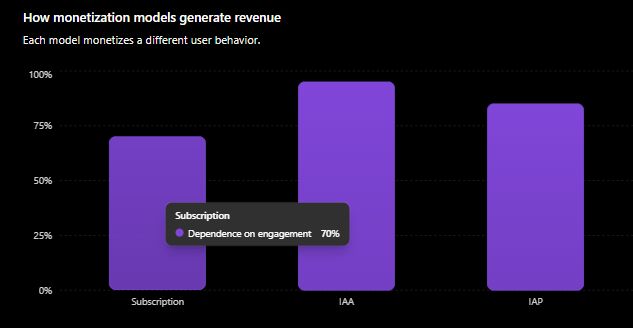
The chart may look simple, but the behaviors behind each model are completely different.
Subscription: Monetizing Continuous Value
Subscription businesses earn revenue by convincing users to pay repeatedly over time.
Think of products like Spotify, Netflix, Duolingo, or AI-powered productivity apps.
The business isn’t trying to maximize ad impressions or one-time purchases. Instead, it focuses on delivering enough value every month to justify the next payment.
The biggest challenge isn’t getting users to subscribe.
It’s giving them a reason to stay subscribed.
Common Industries
- AI applications
- Streaming services
- Education platforms
- Fitness apps
- Productivity software
IAA: Monetizing Attention
In-App Advertising works differently.
Users don’t pay directly. Advertisers do.
Every session, video view, or interaction creates opportunities to generate ad revenue. That’s why this model thrives on engagement and scale.
If users stop opening the app, revenue stops as well.
This is why many casual and hyper-casual games focus heavily on retention, session frequency, and ad placements.
Common Industries
- Casual gaming
- Hyper-casual gaming
- Utility apps
- Content platforms
IAP: Monetizing Commitment
If subscriptions monetize value and IAA monetizes attention, IAP monetizes commitment.
This model is particularly powerful in gaming because players often become emotionally invested in progression, competition, customization, or status.
Most users never spend.
A small group of highly engaged users often generates the majority of revenue.
The challenge is creating enough value that spending feels like a natural extension of the experience.
Common Industries
- Mobile gaming
- Social casino
- Strategy games
- MMORPGs
- Creator platforms
Why Hybrid Models Are Winning
Interestingly, many of the most successful apps today don’t choose just one model.
They combine them.
A user may:
- Watch ads
- Make occasional purchases
- Eventually upgrade to a subscription
This is why products such as YouTube, Spotify, Duolingo, and many gaming companies operate multiple monetization streams simultaneously.
Different users create value in different ways.
Final Thoughts
The best monetization model isn’t the one that generates the most revenue on paper.
It’s the one that matches how your users naturally behave.
Subscriptions reward long-term value.
Advertising rewards engagement.
In-app purchases reward emotional investment.
The most successful mobile businesses understand this simple principle:
Don’t force users into a monetization model. Build a monetization model around your users.